
Why CTRL [SPACE] feels written for the surveillance systems of 2026
A book about Panopticons, webcams, video art, and intelligent cameras offers a surprisingly useful history of the systems watching us now.
In a recent NPR photograph from Crystal, Minnesota, Brady O’Rourke stands beside an ordinary city street holding a bright yellow sign in front of a Flock camera. The sign is attached to a roof rake. It reads, DEFLOCK CRYSTAL.
Brady O’Rourke blocks the view of a Flock camera in Crystal, Minnesota. Photograph by Meg Anderson / NPR.
The image is almost funny: a homemade object physically interrupting a sophisticated surveillance network. But the reaction behind it is serious. Flock cameras have become part of a national argument about what happens when public streets are transformed into searchable records of where people have been. As NPR reported in August 2026, people are responding through protests, city-council campaigns, contract cancellations, camera-blocking demonstrations, and in some cases, destruction of the cameras themselves.
By now, Flock cameras hardly need an introduction. What interests me is the longer story behind them. How did surveillance move from an architectural idea to a device on the street, and then from a device into a network that can search the past?
A massive book published in 2002 offers an unexpectedly useful answer.
A history of watching and being watched
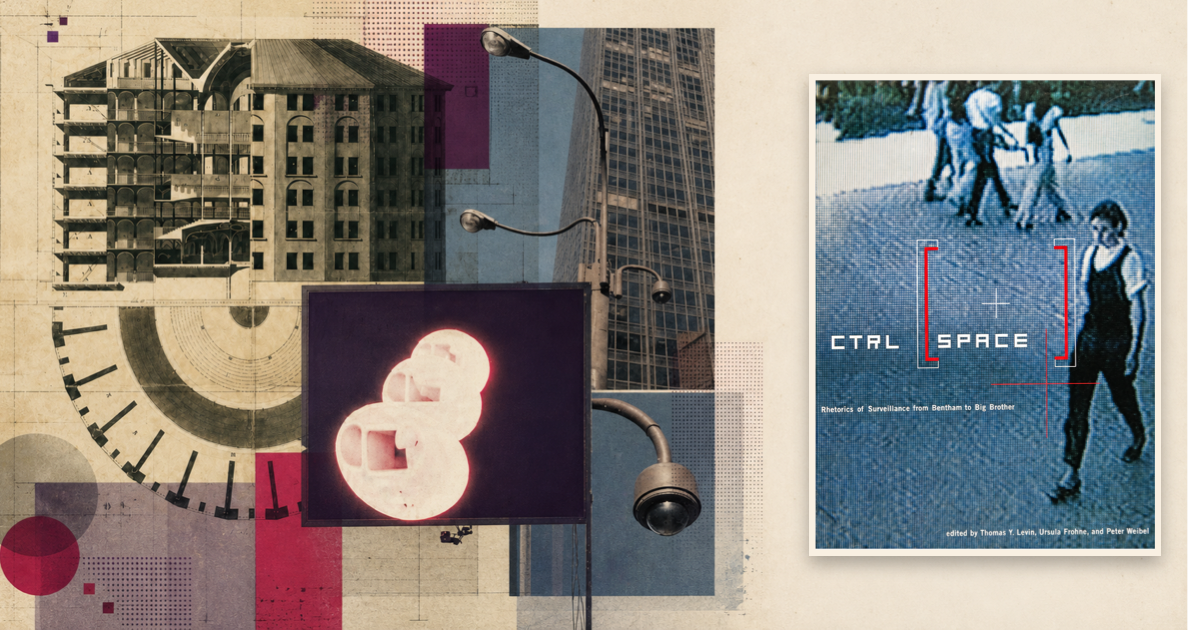
CTRL [SPACE]: Rhetorics of Surveillance from Bentham to Big Brother, edited by Thomas Y. Levin, Ursula Frohne, and Peter Weibel and published by ZKM and the MIT Press in 2002.
CTRL [SPACE]: Rhetorics of Surveillance from Bentham to Big Brother was edited by Thomas Y. Levin, Ursula Frohne, and Peter Weibel and published by ZKM and the MIT Press. It accompanied a major exhibition at the ZKM Center for Art and Media in Karlsruhe, Germany.
The book moves through architecture, photography, cinema, television, video art, robotics, satellite imaging, and digital culture. Its subject is not simply the surveillance camera. It is the relationship between design and power: who gets to look, who becomes visible, what an image can be made to do, and how people behave when they know (or merely suspect) that they may be watched.
The MIT Press description calls the book a history of surveillance in relation to changing systems of representation and visual-art practice. That description is accurate, but it undersells how current the book feels. Reading it now is like finding a map of the present drawn before many of today’s systems had become ordinary.
The book documented the ideas and habits that made systems like Flock possible.
The camera changes behavior before it records anything
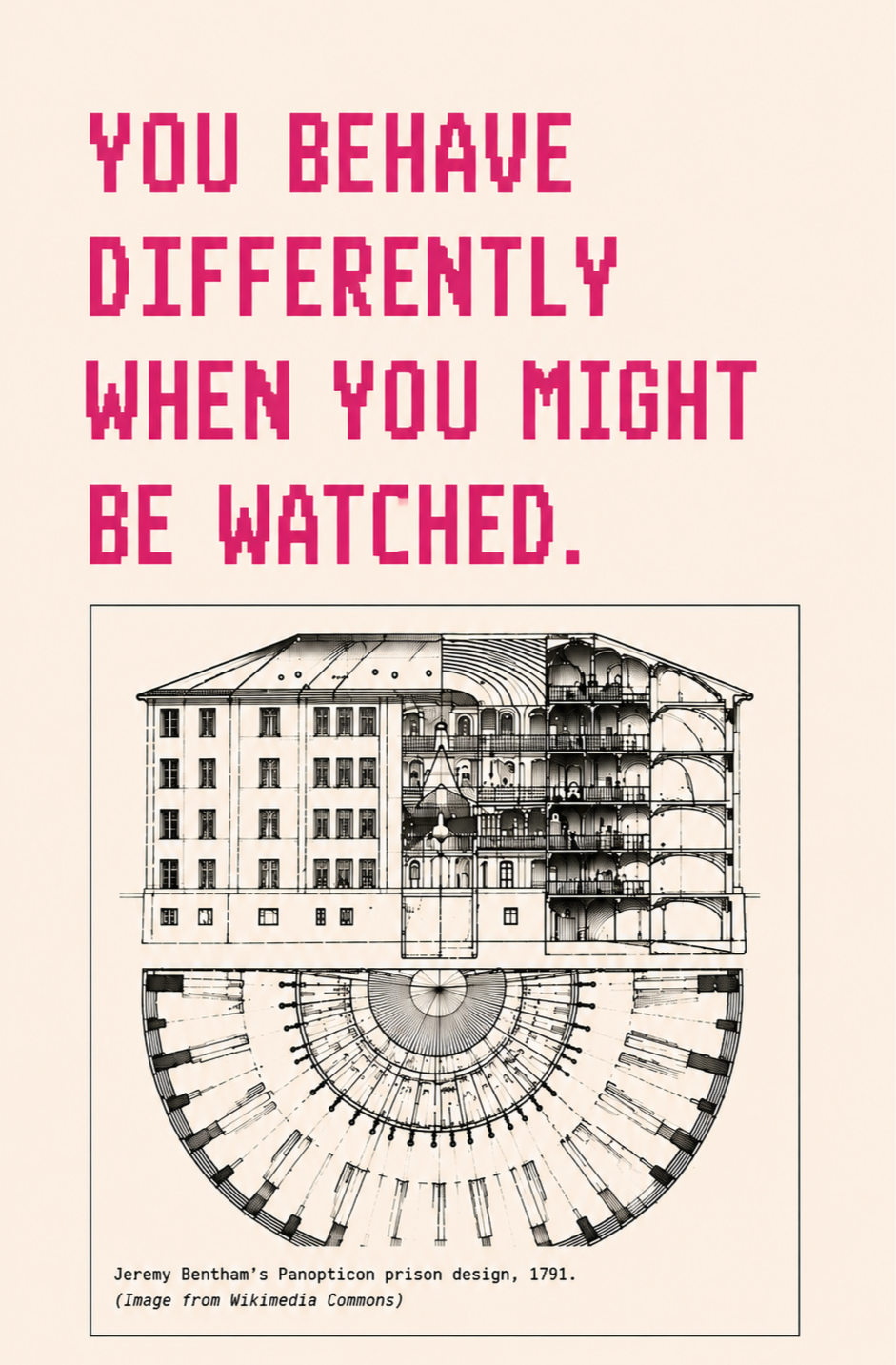
The story begins with Jeremy Bentham’s eighteenth-century Panopticon: an architectural design in which one observer could potentially watch everyone, while the people being watched could never know when someone was actually looking.
The important part is the uncertainty the subject feels.
If you might be watched at any moment, you begin to behave as though you are always being watched. The architecture distributes power without requiring an observer to look continuously. The possibility of surveillance becomes a form of discipline.
That idea still matters because surveillance is never only about the image captured. It also changes the space around the camera. A camera at the end of a block can affect how a street feels, how people move through it, and what they imagine could later be reconstructed about their lives.
From counting cameras to searchable streets
One of the projects reproduced in CTRL [SPACE] is the New York Civil Liberties Union’s 1998 Surveillance Camera Project. Volunteers walked every block of Manhattan looking for surveillance cameras and documented 2,397 of them. They believed the real number was probably higher.
There is something both radical and quaint about that method now. The volunteers had to look up, notice each physical camera, mark its location, and make the network visible by counting it.
![New York Civil Liberties Union Surveillance Camera Project, 1998. Reproduced in CTRL [SPACE].](https://images.squarespace-cdn.com/content/v1/5318df51e4b0d5b5621a6b1c/f436fc53-c6da-47e6-87f3-9782543043c8/ctrl-space-surveillance-camera-book-spread-restored.png)
New York Civil Liberties Union Surveillance Camera Project, 1998. Reproduced in CTRL [SPACE].
Today, the important question is no longer only how many cameras exist. The scale has nevertheless changed dramatically: in 2021, Amnesty International mapped 15,280 surveillance cameras across Manhattan, Brooklyn, and the Bronx whose images could be used in NYPD facial-recognition searches. What matters now is what happens after an image is captured. A contemporary camera can be part of a larger system that identifies features, associates them with a time and place, stores the resulting record, and makes that record available for later searches.
The street does not merely become visible. It becomes queryable.
When being watched becomes something we choose
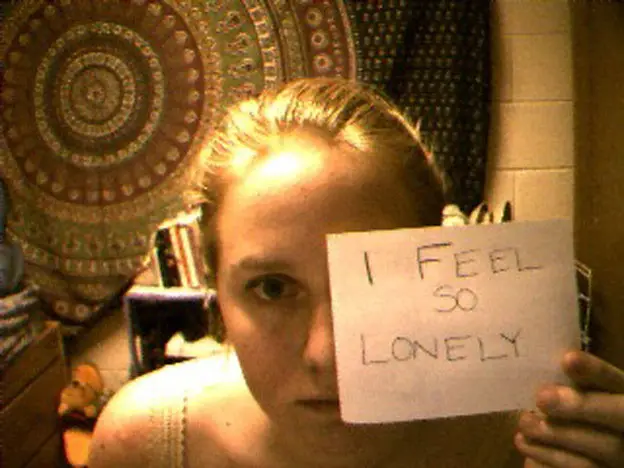
Jennifer Ringley’s JenniCam began broadcasting everyday life online in 1996.
The book also complicates the familiar story of surveillance as something imposed from above.
In 1996, on the eve of her twenty-first birthday, Jennifer Ringley installed a webcam in her dorm room and began broadcasting ordinary parts of her life through JenniCam. Years before TikTok, Twitch, or continuous live-streaming became familiar, she turned observation into participation. She was the first web-based "lifecaster" to stream her life on the internet.
JenniCam asks a question that feels even more important now: what happens when visibility becomes something we choose?
The person being watched is not always forced into the frame. Sometimes we place ourselves there. We trade visibility for connection, attention, entertainment, convenience, or the possibility of being known. That does not make the power relationship disappear. It makes it more complicated.
The history of surveillance is therefore also a history of desire. We do not only fear the camera. We perform for it, speak through it, and build identities around it.
Then the cameras started thinking
Peter J. Cornwell, Surveillance of Assailants, 2000–01. Installation using real-time video analysis and responsive software; reproduced in CTRL [SPACE].
The eeriest parts of CTRL [SPACE] concern cameras that do more than record. Artists in the book were already working with real-time video analysis, pattern recognition, databases, and software that responded to human behavior.
Peter J. Cornwell’s Surveillance of Assailants (2000–01), for example, used video analysis and software that reacted to the behavior of viewers. The artwork makes the camera feel less like a passive witness and more like an active participant.
That distinction is essential. Once a camera begins interpreting what it sees, the image becomes an input. It can be classified, compared, connected to other records, and used to trigger a decision.
This is the conceptual bridge between the artworks in a 2002 exhibition catalogue and the cameras appearing along city streets today.
Flock cameras make movement searchable
Flock’s cameras are automated license-plate readers. According to Flock’s own product description, its system can capture vehicle details and turn them into searchable evidence. The device is only the visible edge of that system. The more consequential part is the database behind it.
That is why the present backlash cannot be understood as a reaction to a box on a pole. The argument is about the creation of a searchable history of ordinary movement: trips to work, school, a doctor, a friend’s home, a protest, a place of worship, or anywhere else a vehicle might pass.
Supporters point to stolen vehicles, missing people, and other investigations in which license-plate data may help. Critics point to indiscriminate collection, data sharing, errors, weak oversight, and the possibility of abuse. The ACLU’s campaign against automated license-plate-reader networks focuses on precisely this shift from individual cameras to connected systems capable of tracking movement at scale.
CTRL [SPACE] helps clarify what is at stake without requiring us to pretend the technology appeared from nowhere. Surveillance moves from architecture to images, from images to databases, and from databases into everyday space.
Surveillant literacy
The phrase I keep returning to from the book is surveillant literacy.
Practicing surveillant literacy means doing more than noticing a camera. It means understanding the system around it. Who operates it? What does it collect? How long is the information retained? Who can search it? What other databases can it be connected to? How often is it wrong? What happens when it is wrong? Can a person challenge the record or even discover that it exists?
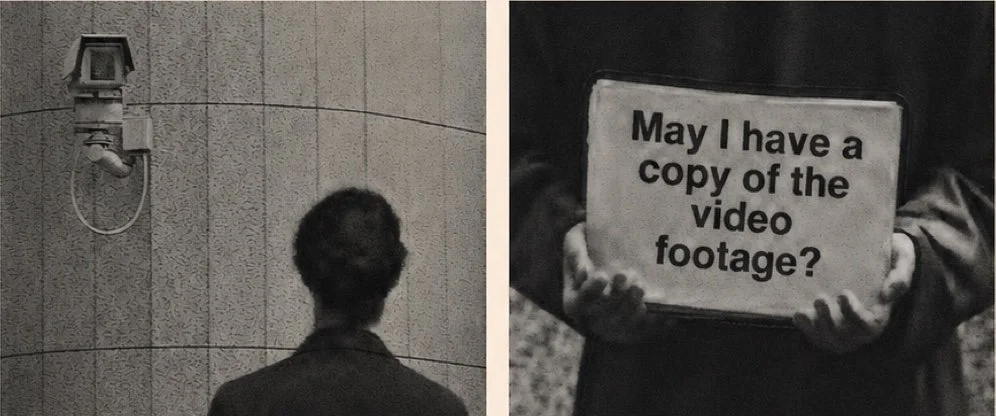
Denis Beaubois, In the Event of Amnesia the City Will Recall, Parts I & II: Sydney & Cleveland Performance, 1996–1997, black-and-white video, 7:41 minutes. Reproduced on page 608 of CTRL [SPACE].
This is why CTRL [SPACE] is worth reading now. Its value is not that it predicted every new device. Its value is that it gives us a history for recognizing recurring relationships between watching, power, technology, and behavior.
New surveillance products often arrive wrapped in the language of novelty and inevitability. History interrupts that story. It reminds us that these systems were designed, funded, installed, normalized, contested, and sometimes removed. They could have been built differently. They can still be governed differently.
The camera at the end of the block is the latest visible part of a much older system.
Read the book
CTRL [SPACE] is currently out of print, but there are two ways to find it:
- Borrow CTRL [SPACE] through the Internet Archive. This is an access-restricted lending copy, so a free account and borrowing step may be required.
- Buy a copy of CTRL [SPACE] through my Amazon affiliate link. As an Amazon Associate I earn from qualifying purchases.