

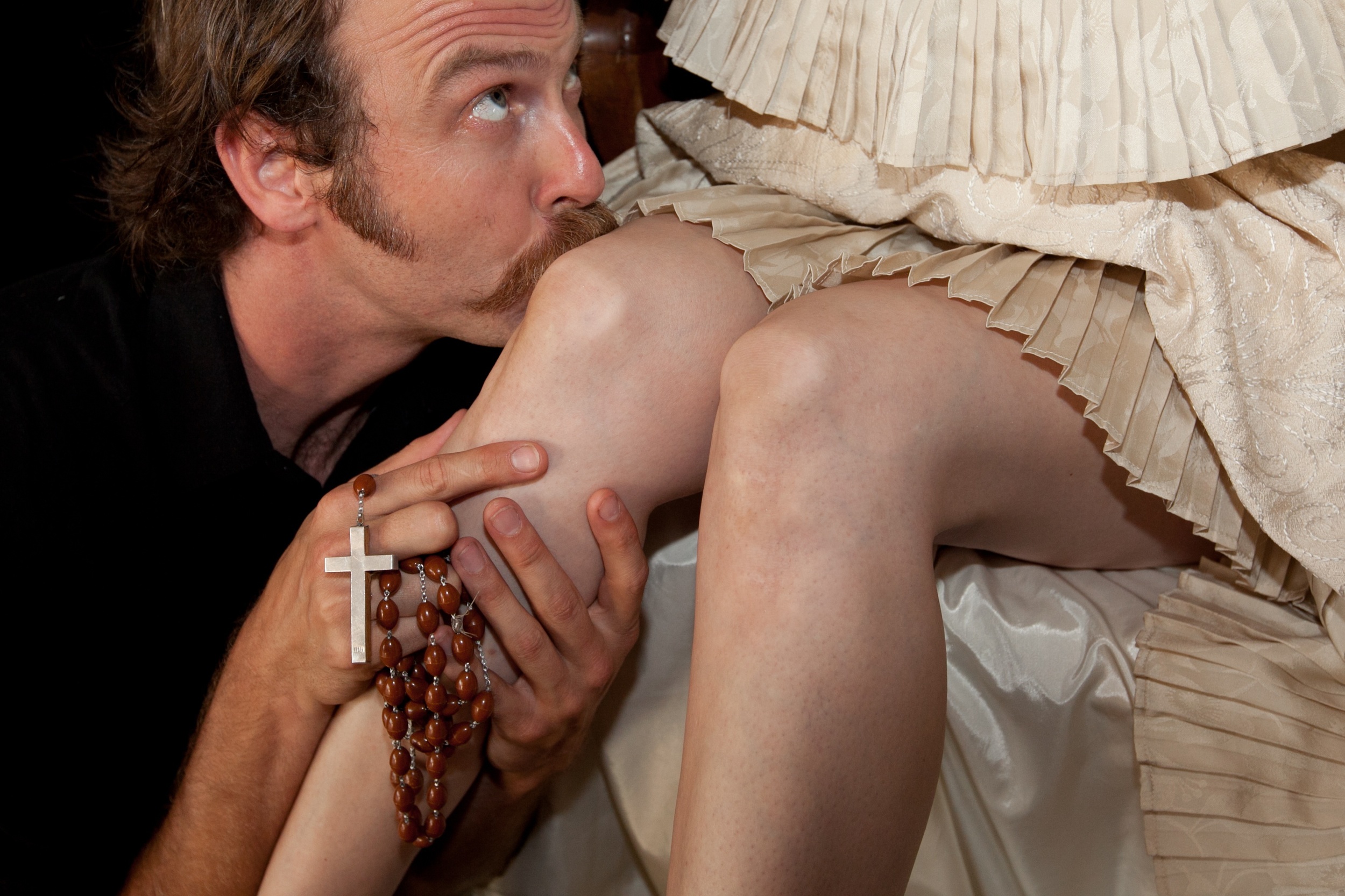
 I was lucky to have been invited to Rapid Descent's version of Moliere's Tartuffe by a Ko-llaborator and friend who was performing in the piece. It was directed by Megan Finlay, who formed the company two years ago, to explore the combination of movement and text with live music. Tartuffe is a classic French comedy, first staged in 1664 and censored by the king and archbishop of Paris on the grounds of the questionable virtue of the swindler, Tartuffe.
Rapid Descent's Tartuffe was playful and precise. It was whimsey and rhyme wrapped in an exaggeratedly physical container. The performers were working in sync to complete tumbles over and under couches, out windows, and through each other's arms. All the while this near constantly choreography continued, the performers were delivering precise and rhyming text. Meandering through the scenes was a trumpet player, playing music for the audience and sometimes playing with the performers in the scenes. The speed and tension of the play just, worked. The characters were directed and bold and the energy of the piece flowed fast from one scene to the next.
I was lucky to have been invited to Rapid Descent's version of Moliere's Tartuffe by a Ko-llaborator and friend who was performing in the piece. It was directed by Megan Finlay, who formed the company two years ago, to explore the combination of movement and text with live music. Tartuffe is a classic French comedy, first staged in 1664 and censored by the king and archbishop of Paris on the grounds of the questionable virtue of the swindler, Tartuffe.
Rapid Descent's Tartuffe was playful and precise. It was whimsey and rhyme wrapped in an exaggeratedly physical container. The performers were working in sync to complete tumbles over and under couches, out windows, and through each other's arms. All the while this near constantly choreography continued, the performers were delivering precise and rhyming text. Meandering through the scenes was a trumpet player, playing music for the audience and sometimes playing with the performers in the scenes. The speed and tension of the play just, worked. The characters were directed and bold and the energy of the piece flowed fast from one scene to the next.
The show had some notable performances. Brian Livingston as Tartuffe managed to sleeze and ooze over the stage at Elmire, Orgon's wife. He had a loose and open physical language punctuated by moments of tension and rapt prayer. Orgon, played by Zack, simpered and hyperventilated in one moment then gracefully tumbled and flowed the next. Addie Ulrey as Dorrine held the first act of the play together with her quick delivery, steady energy, and witty physical banter with the musician onstage.
The space, Shotwell Studios, which lends itself to dance pieces and small theater well, was reconfigured and the back wall painted a bright (almost garishly so) color, but it worked to create the livingroom wall, with windows and all. The couch the company used for the piece must have been forged in the fires of Mordor, because it took a beating! They stomped, fell, lept, skipped, stood, jumped and tumbled over and onto that couch.
The crowning moment of the piece was immediately after the intermission. The trumpet player had set up a series of live loops of trumpet to start out the piece. One by one the performers filed onto stage and began performing a series of movements without words, which I quickly realized were the exact movements from the first act. They performed a fast take of every single movement from the first act at a blinding pace and it was hysterical. They say comedy is drama sped up, but what happens when you speed up comedy? This great piece of theater, that's what.
I will keep my ear to the ground for Rapid Descent and I hope to see more from this emerging company.