
My project deals with the question, how does technology mediate our relationships with each other? Does it contribute or disrupt human closeness and connection?
Read MoreNight Sky Web Animation
The Night Sky explores html5, CSS via Sass in the form of a night sky. I used css and the transition tag to create all of the animations you see. Click on the image to interact with the animation. Wait a little bit for the surprise at the end before leaving!


#2 Response to Jamer Hunt in Text and Object
Jamer Hunt’s article, "Prototyping the Social", creates a careful triad between design, social responsibility, and cultural anthropology. Hunt uses Tony Fry’s theory of “defuturing” as a foundation for his analysis of the role ethnography is playing in shaping the design of our cultural experiences and potentially every aspect of life from cleaning products to genetic modification. As stated below, Hunt leads with a warning to designers about the danger in creating for profit and functionality alone, without considering the consequences and future implication of design choices. Defuturing is, for Fry, not simply the law of unforeseen consequences. Instead, it is a conceptual mindset inherent to a style of designing that privileges the instrumental over the social. Designers ignore - at our own and others' peril-the extent to which any act of design is an act both of prefiguring a future social milieu but also the erasure of multiple possible alternatives. Design, for Fry, both designs and keeps on designing. It is an ontology of prefigurement that destroys as it creates. [1]
Fry’s notion of defuturing is important because it provides designers with stakes beyond price point, commercial success, and seemingly usefulness. For Hunt each design, system or object created becomes entwined in the “erasure of multiple possible alternatives” that never got finished.
For example, I like to imagine what Chicago O’Hare would look like if it were designed today. Would it have a central tower? Would it be circular? How would the role of computer networks affect the layout and transportation within the airport? The design is locked into time, but as Hunt says, it keeps on designing, even after it is finished.
When one imagines the impact something like that airport has had on millions of people over decades, the sheer weight of a design poorly executed is staggering. In this day and age of disposable digital design and emerging 3D printing technology I believe Fry and Hunt have more applicability in terms of imagining designing for waste management then perhaps the creation of objects with longevity.
[slideshow_deploy id='1187']
In response to Hunt and Fry’s notions of defuturing and erasure of alternatives within the design process, I will create an object that imagines multiple alternatives. I will also create something that considers it’s own lifespan. Temporality will be addressed in an attempt to confront the issues of social responsibility, usefulness, and waste management. I want my design to embrace it’s own entropy. I chose to hand sew a cup protector out of recycled felt. The piece is decorated with hand stitched lettering of the word "Defuture" to serve as a constant reminder of the choices I make. I intend to daily use this item with my coffee, not only to reduce the waste of disposable cup warmers, but also to remind myself to think of the future consequences of my daily and design actions.
[1] Clarke, Alison J. "Chapter Two." Design Anthropology: Object Culture in the 21st Century. Wien: Springer, 2011. 36. Print.
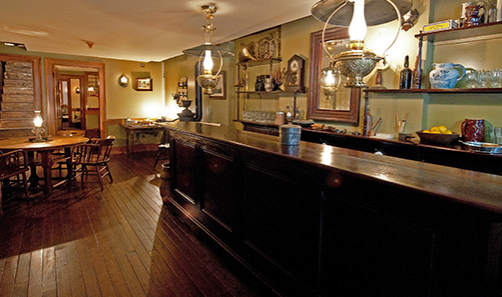
The interior of the first shop.
Tenement Museum of New York - Stories of the Past Meet Innovations of the Future
It was a snowy Monday during February in the Lower East Side of Manhattan when I visited the Tenement Museum. I had expected to walk up and down the narrow staircases of the Five Floor building, peering into dusty recreations of the original apartments in the building, 97 Orchard Street.
Read More