
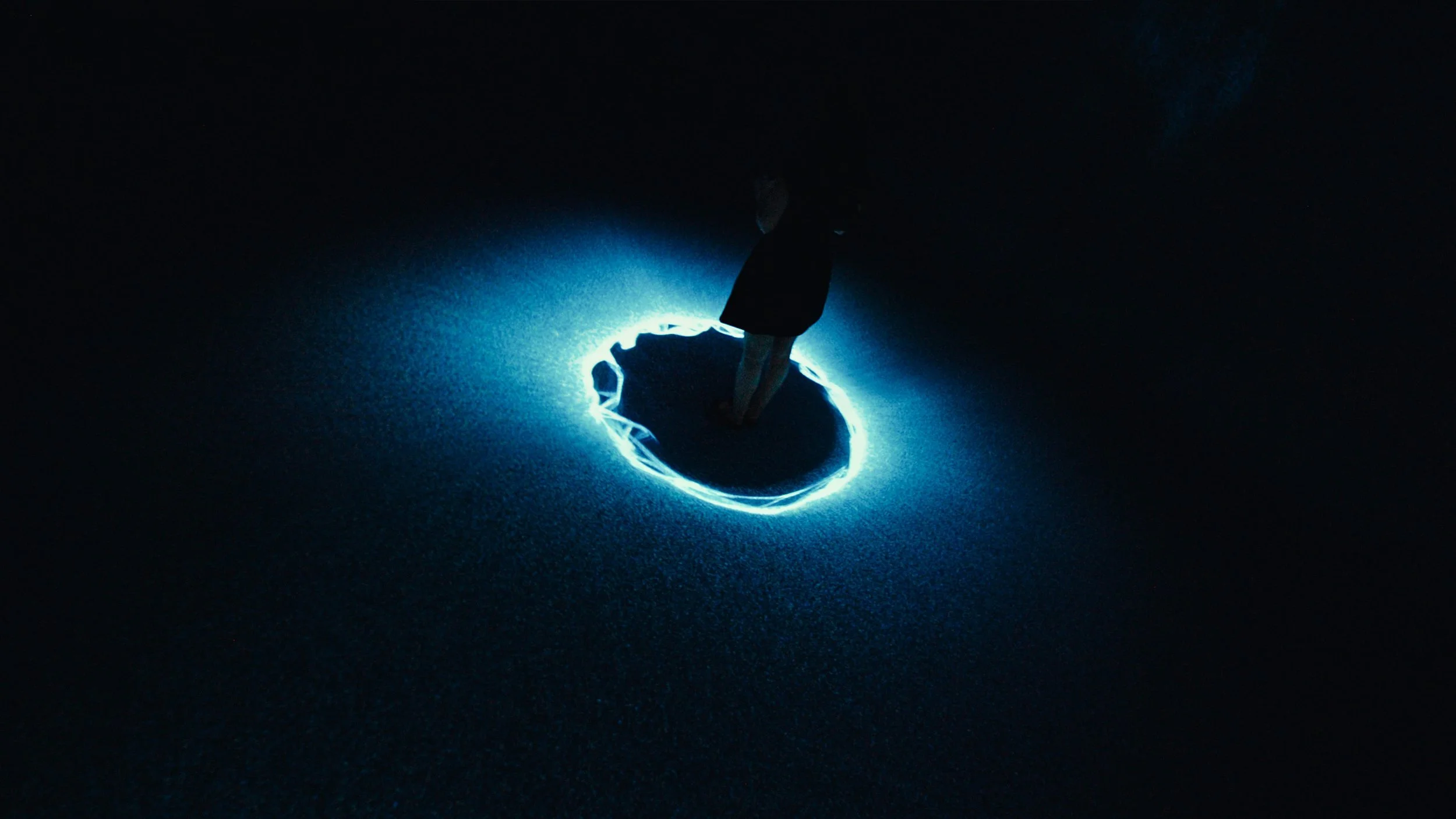
Refik Anadol’s DATALAND describes itself as the world’s first Museum of AI Arts. Whenever a cultural institution calls itself “the first,” I want to ask: first at what?
It is a meaningful claim, but not because AI art suddenly appeared inside a museum. Artists and cultural institutions have been experimenting with neural networks, generative systems, immersive environments, and responsive media for years.
What feels new is the scale of the proposition. DATALAND is not presenting AI as the subject of a temporary exhibition. It is building an institution around art that is generated, sensed, updated, and experienced as a living system.
That distinction matters. The story is not simply that AI has entered the museum. It is that the museum itself is becoming computational, responsive, and alive.
The first exhibition is not the first museum
In 2016, Gray Area and Google presented DeepDream: The Art of Neural Networks in San Francisco. Google Arts & Culture describes it as the world’s first exhibition of generative AI art. Eleven artists showed more than 30 works made with neural networks, at a moment when the visual language of AI was still unfamiliar to most people.
I remember how strange those images felt then. They were psychedelic, unstable, and unmistakably machine-mediated. The exhibition offered the public a first glimpse of what happens when a neural network becomes more than a technical tool, when it becomes part of an artist’s process and part of the cultural conversation.
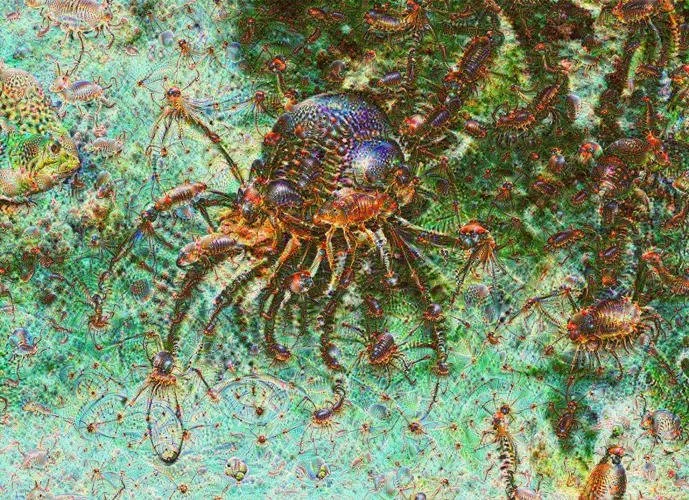
Installation documentation from DeepDream: The Art of Neural Networks, Gray Area, 2016. Image: Gray Area.
Calling DeepDream the first generative AI art exhibition and DATALAND the first museum of AI arts is not a contradiction. The space between those claims is the story: an experimental medium becoming an exhibition, an experience, and eventually an institution.
When the artwork became a world
The same year, Meow Wolf opened House of Eternal Return in Santa Fe. More than 100 artists transformed a 33,000-square-foot former bowling alley into a permanent, explorable world. Visitors did not stand outside the artwork and contemplate it from a safe distance. They opened doors, crawled through portals, followed narrative fragments, and built their own understanding through movement.
That shift—from looking at an artwork to entering one—changed public expectations. Meow Wolf’s account of the project makes clear how collective and spatial the work was. The exhibition was not a room containing separate objects. The room, the story, and the visitor’s path through them formed the artwork together.
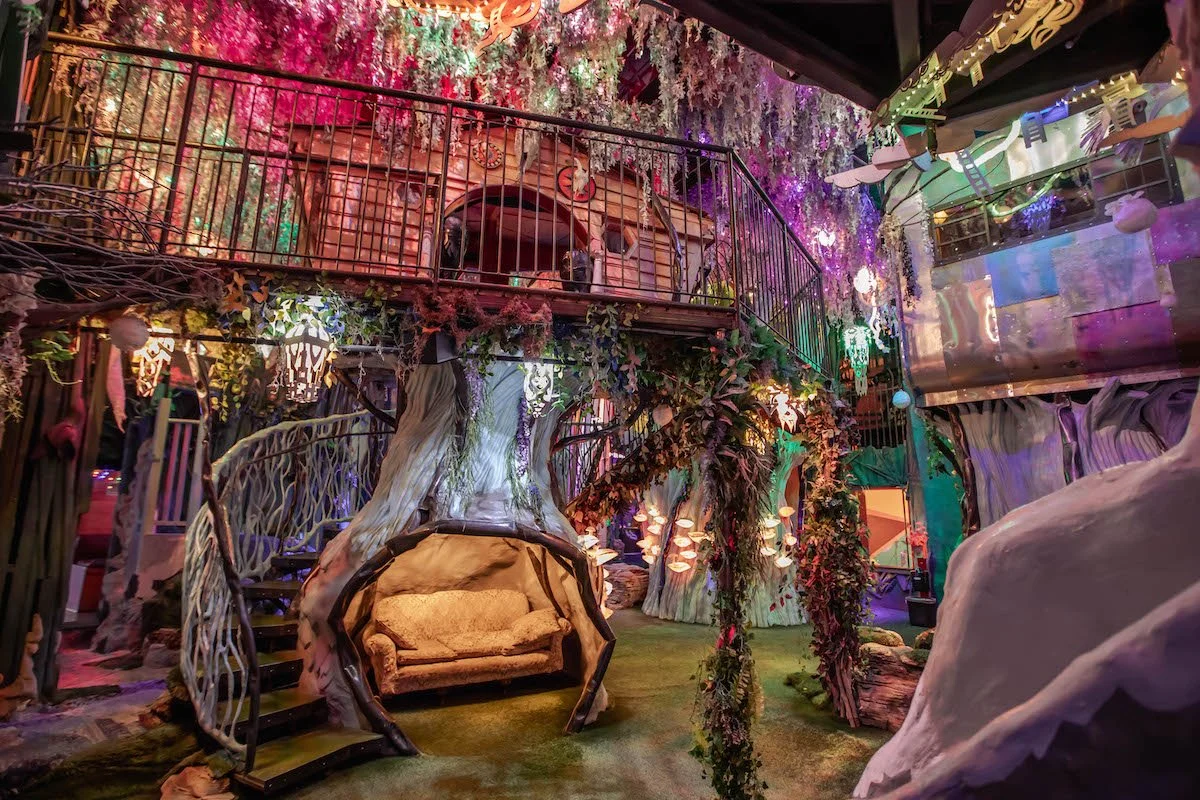
The Treehouse inside the Forest at Meow Wolf’s House of Eternal Return. *Photo by Kennedy Cottrell; image: Meow Wolf.
From immersion to agency
At Gray Area, I helped lead the Experiential Space Research Lab, or ESRL. We were interested in immersive art not simply as spectacle, but as a critical-thinking tool. What could an environment help a person feel, understand, or question? How could sensors, spatial audio, projection, and interaction create agency rather than passive consumption?
Those questions culminated in The End of You in 2020, Gray Area’s first large-scale immersive exhibition. Seven room-scale works used projection mapping, spatial audio, and sensors to examine the relationship between humans, technology, and living systems. Gray Area’s announcement for the exhibition described it as the outcome of a year-long collaboration between Gray Area and Gaian Systems.
For me, this chapter is essential to understanding the road to DATALAND. An immersive room can surround you with extraordinary images, but responsiveness creates a different relationship. The visitor is no longer merely inside the artwork. The visitor begins to affect it.
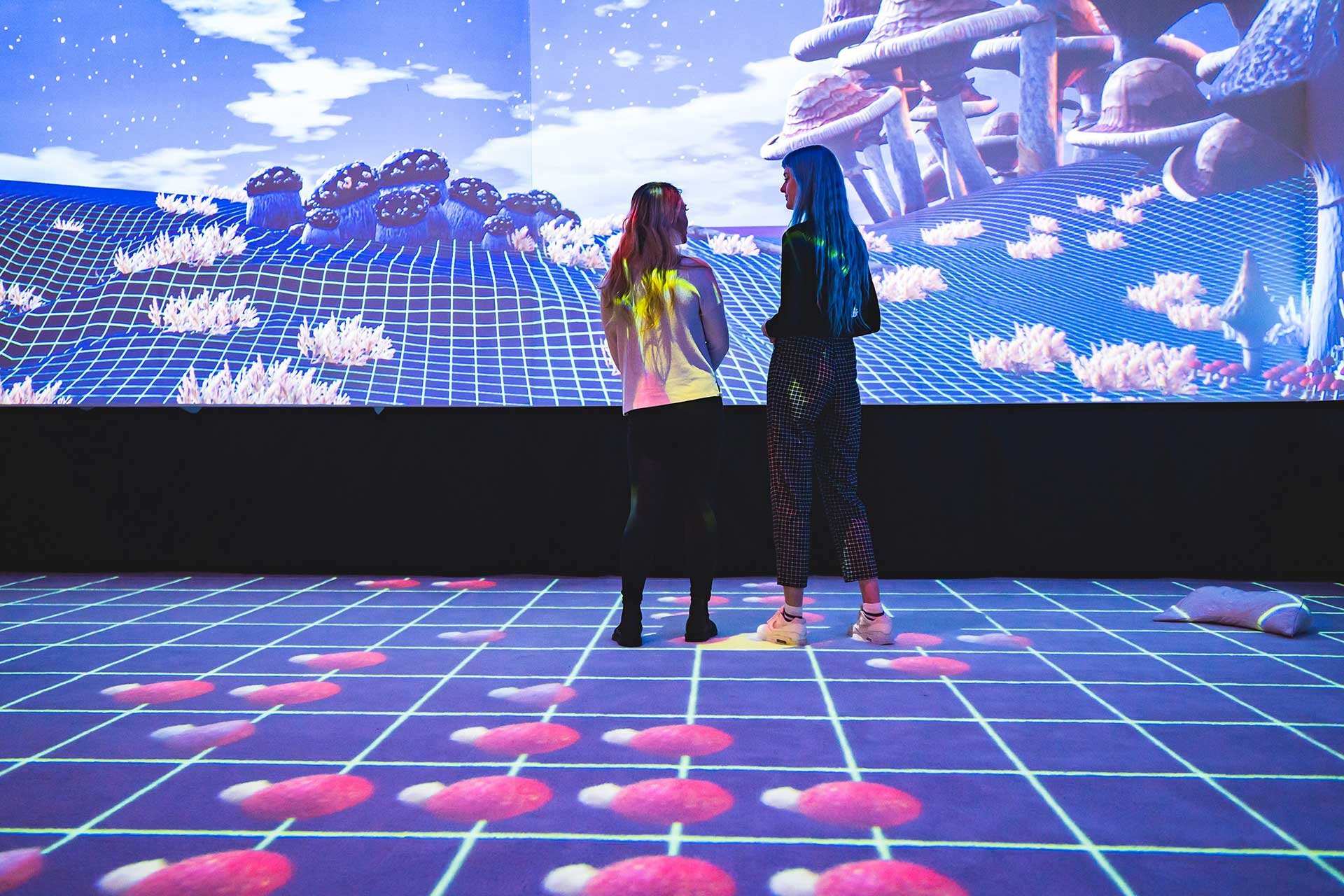
Installation view of The End of You, *Gray Area, 2020. Photo by Naveed Ahmad; image: The End of You.
Immersion becomes a mass medium
Then immersive projection became mainstream. Experiences such as Van Gogh: The Immersive Experience introduced enormous audiences to rooms filled with moving images and sound. They made art history spatial, social, and highly photographable.
There is a fair critique of this format: immersion can flatten complex work into atmosphere, and spectacle can substitute for interpretation. But its popularity also demonstrated something museums could not ignore. People wanted to inhabit images. They wanted to move through culture rather than only observe it on a wall.
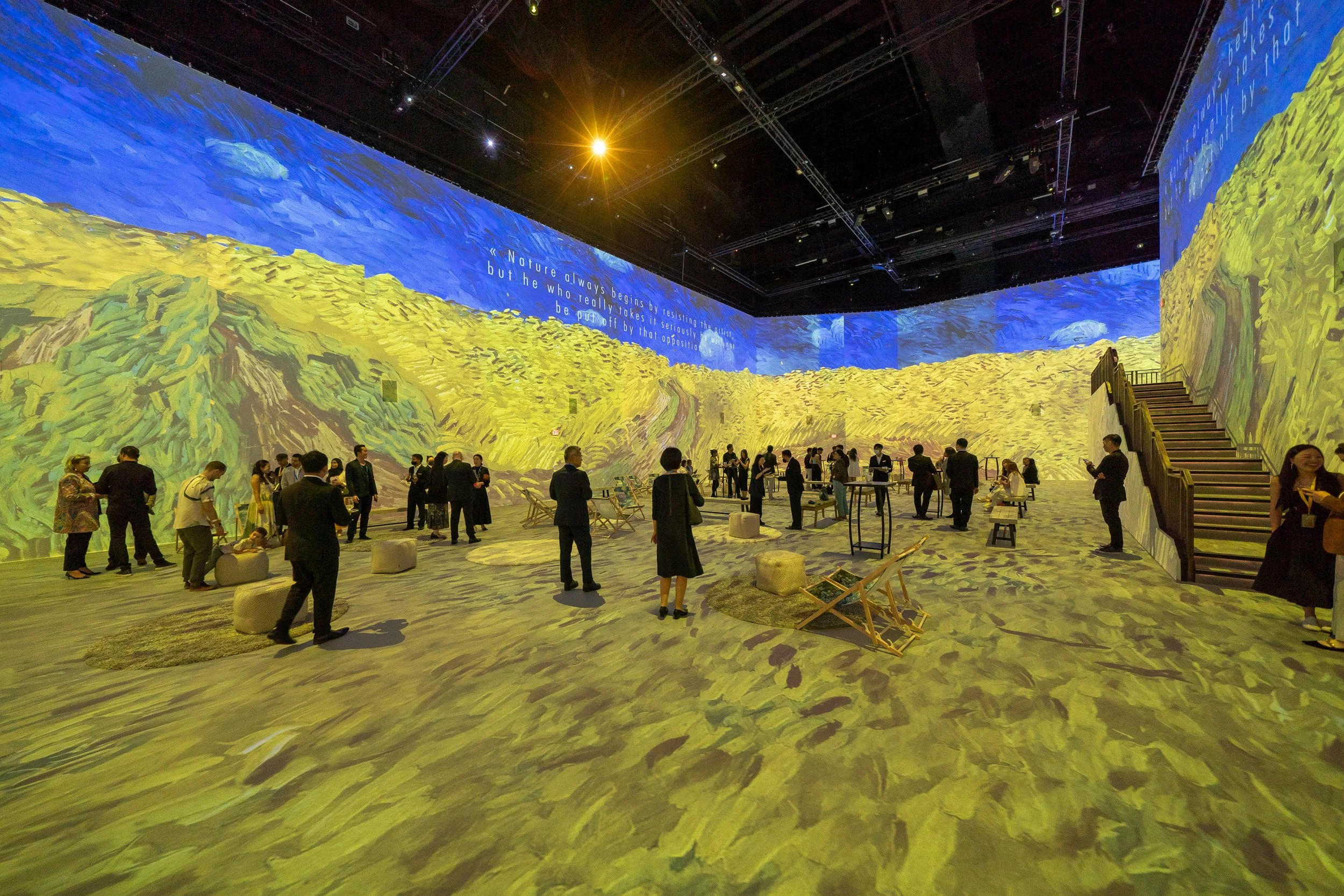
Van Gogh: The Immersive Experience. Image: Exhibition Hub / Fever media kit.
What DATALAND changes
DATALAND is the project of media artist Refik Anadol, whose relationship with Gray Area predates the museum. In January 2020, Gray Area presented the West Coast debut of Bosphorus and Black Sea, two kinetic data sculptures Anadol created using high-frequency radar data from the Black Sea. Those works already centered a question that animates DATALAND: how can data drawn from nature become a spatial, audiovisual experience?
DATALAND brings these threads together: AI-generated imagery, immersive space, environmental data, and visitor participation. Its inaugural exhibition, Machine Dreams: Rainforest, is built from a Large Nature Model trained on an ethically curated ecological archive and original fieldwork. According to DATALAND’s exhibition description, the installation draws from more than 1.2 billion ecological data points and uses 84 high-resolution projectors, a 200-channel soundscape, scent, and interactive systems.
But the technical scale is not the most interesting part. The work changes in relation to time, incoming data, and the people inside it. Movement, proximity, and biosensing can influence what a visitor encounters. DATALAND calls these “living artworks”—works that do not resolve into one fixed, final state.
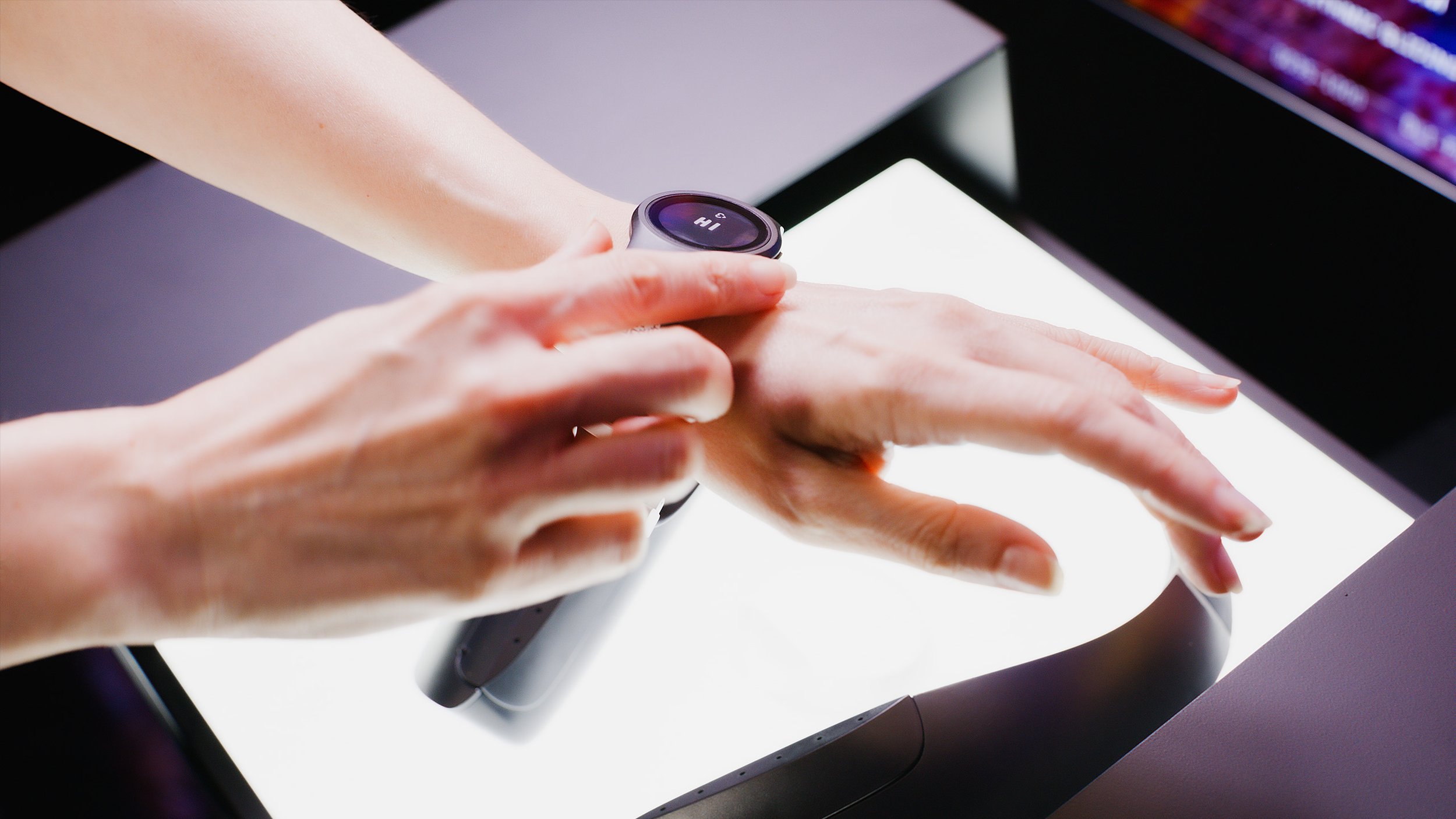
A Data.Link biosensing device being placed on a visitor. Image: DATALAND.
This changes the institution’s job. A traditional museum preserves an object. A living museum may need to preserve a system: its data, model, software, interfaces, behavior, and the conditions under which it changes. If every encounter is different, what exactly enters the collection? What counts as the authentic work?
A living museum needs living ethics
I am optimistic about this evolution, but I do not think “responsive” automatically means meaningful or ethical.
If datasets become cultural material, their provenance matters. Who gathered the data? Who consented to its use? What communities, species, and environments are represented, and which are absent?
If a visitor’s body becomes an input, consent cannot be buried in the experience. People should understand what is sensed, what is stored, and what control they retain.
If software and models determine what visitors see, museums need ways to document their versions, biases, and failures. Preservation can no longer mean freezing an object in time. It may mean preserving the ability to understand how a changing system behaved and why.
And if spectacle is the doorway, critical context still has to be in the room. Wonder and scrutiny are not opposites. The most important cultural institutions make space for both.
DATALAND says its digital ecosystem will include learning resources, a public repository of nature datasets, and a collection of AI art, alongside commitments to ethical data gathering and AI practices. That broader mission is where the project becomes more than a spectacular venue. It has the opportunity to model how a cultural institution can collect, interpret, and question computational culture in public.
The museum is becoming a system
DATALAND did not appear from nowhere. It belongs to a history shaped by artists teaching neural networks to make images, collectives building worlds people could enter, laboratories treating immersion as a tool for inquiry, and audiences learning to expect culture to move around them.
The next step is not just a bigger screen. It is a museum that senses, processes, and changes.
That possibility is exciting. It also gives museums new responsibilities. When an artwork is trained on the world, responsive to our bodies, and different each time we visit, cultural memory becomes something active rather than fixed.
The question is what a living museum should remember and what it should be allowed to forget.
If you came here from the Reel, this is the longer history behind it. What do you want from a museum that can respond to you? I’d love to hear your thoughts on Instagram.
Sources and further reading
- DATALAND — About
- DATALAND — Machine Dreams: Rainforest
- DATALAND — “What Makes DATALAND a Living Museum?”
- Google Arts & Culture — DeepDream: The Art of Neural Networks
- Gray Area — DeepDream: The Art of Neural Networks
- Gray Area — Experiential Space Research Lab Open Call
- Gray Area — The End of You announcement
- Meow Wolf — The Original Meow Wolf: House of Eternal Return
- Exhibition Hub / Fever — Van Gogh: The Immersive Experience media kit
Image credits
- Hero and DATALAND biosensing images: DATALAND official website.
- DeepDream exhibition image: Gray Area.
- House of Eternal Return Treehouse: Meow Wolf; photo by Kennedy Cottrell.
- The End of You installation: Gray Area; photo by Naveed Ahmad.
- Van Gogh: The Immersive Experience: Exhibition Hub / Fever media kit.