• Work
  • Story
  • Writing
  • Teaching
  • Archive
  • Ping Me
Menu

Niki Selken

  • Work
  • Story
  • Writing
  • Teaching
  • Archive
  • Ping Me
wtflogo.jpg

World Translation Foundation: exploring emoji as an abstracted communication form

March 12, 2014

My project deals with the question, how does technology mediate our relationships with each other? Does it contribute or disrupt human closeness  and connection?

The history of this issue has shifted along with culture. As technology advances, traditional avenues for connecting with others around you have become more difficult. Personal visits and aural communication gave rise to letters, letters gave rise to phone calls, phone calls gave rise to emails, email gave rise to text messages, and text messages gave rise to emoji texts, and so on. Each new technology has allowed us to move further from our physical selves connecting with each other.
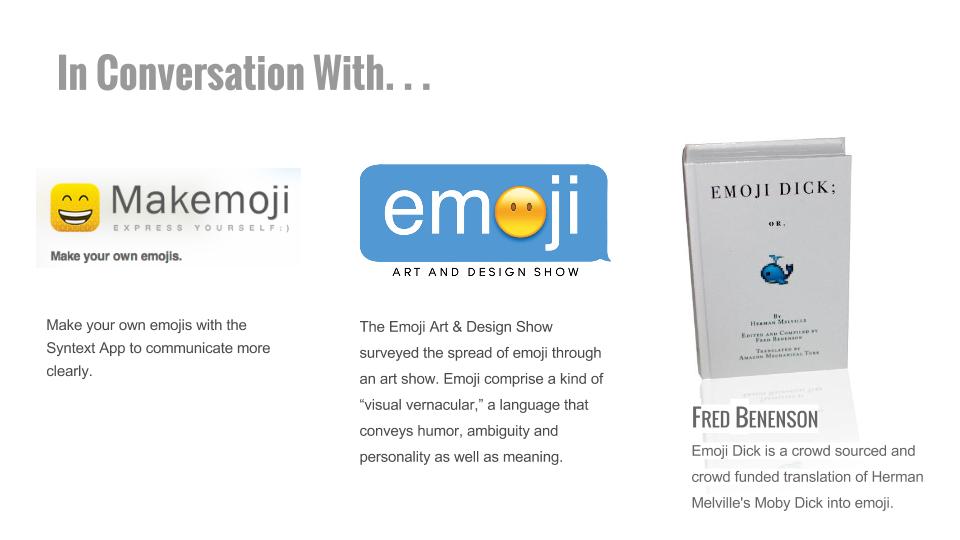
 

Here are a few projects in a similar vein to mine

Here are a few projects in a similar vein to mine

I will tackle the idea of abstracted communication. As we move into abstracted modes of communication such as texts, tweets, and emoji, we should examine, meditate upon and explore the impact this communication upon our ability to connect with each other. By highlighting emoji as creative medium we start to unpack the millions of Emoji texts and messages sent every day, and what might be emerging as a meaning-making tool beyond the chat log. I think of the Hikikomori in Japan, a group of mostly young men in Japan who do not leave their house and live with their parents. Combine this with Japan’s declining birth rate and young people who are losing interest in romantic partnerships and we begin to see the effects of technological disassociation. I do not think it is a coincidence that Emoji is Japanese. There is a connection between people moving away from intimacy and connection as we begin to mediate our communication through more abstracted and reduced forms or technological communications.


Prototype 1: World Translation Foundation Website

I am creating a database, website, and resource hub for art and thinking around these new communication forms. The project is called The World Translation Foundation.

The World Translation Foundation believes that words often get in the way of expressing how we feel. WTF is one part web project, one part tongue and cheek art movement, and two parts serious scholarship. Words can be cumbersome and misleading, and worst of all, they change from country to country. The pictorial alphabet of the emoji lexicon is ubiquitous; easy to use and understand. In a tradition that dates back to the hieroglyphs of ancient Egypt, WTF aims to educate the public in the art of letting art speak for you. Let WTF transform the way you communicate, and pave the way to a quieter tomorrow. Right now the WTF is a website hosted on a custom installation of Wordpress. Contributors include myself and Cara Rose DeFabio.

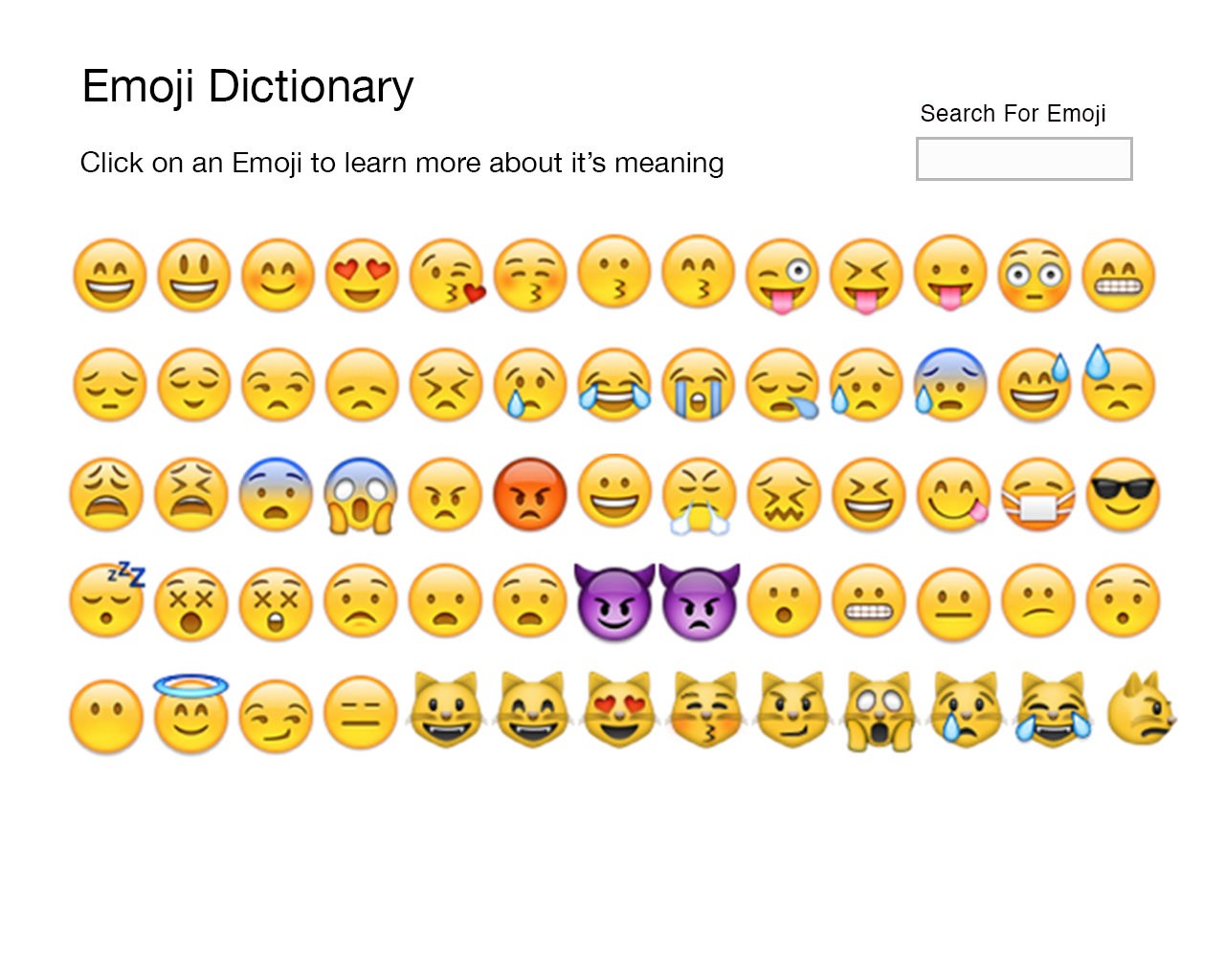
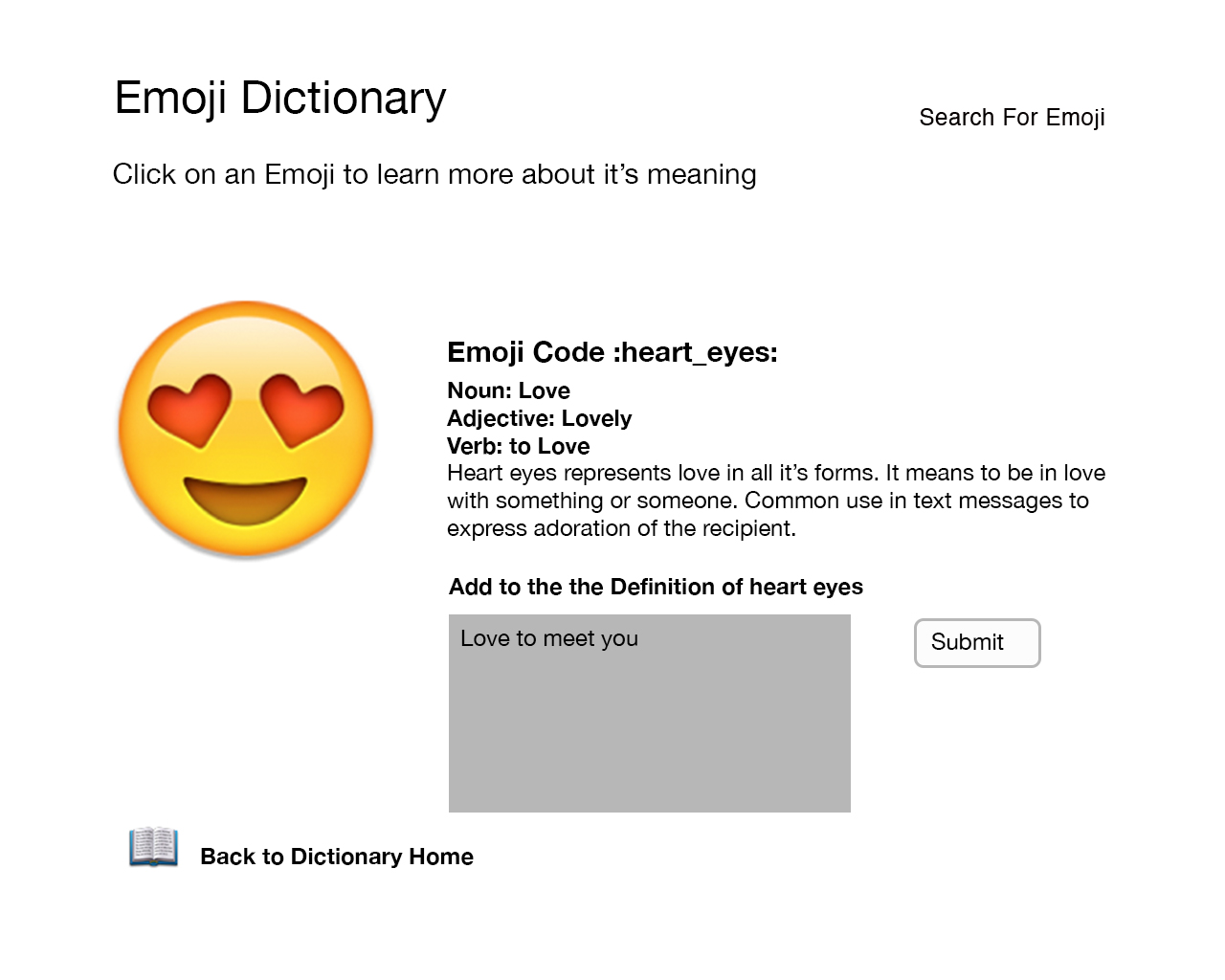
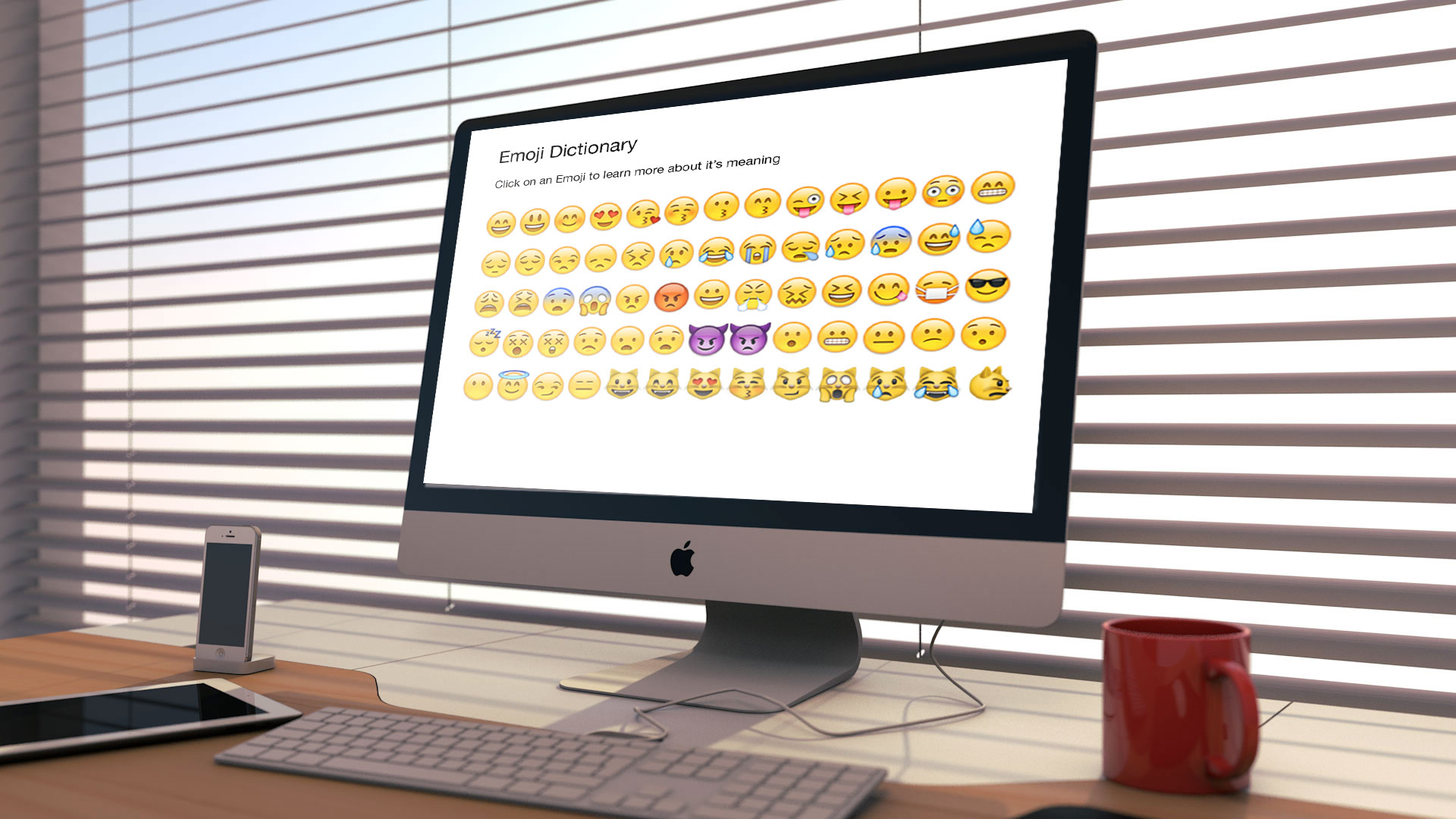
As a means to explore the semiotic impact of Emoji, I am creating the Emoji Dictionary. This is a portion of the WTF website which will be built out using PHP and a MySQL database to store the emoji codes and images as well as definitions. The dictionary will be a living document, allowing users to add to the definitions of each of the emoticons. I will be using Cal Hendersons's PHP emoji library for the project. 


Prototype 2: The Emoji Dictionary Wireframes

Prototype 3: The Emoji Dictionary Design Comp
imacemoji.jpg
emojidectionary.jpg
Emojiclose.jpg
imacemoji.jpg emojidectionary.jpg Emojiclose.jpg
In Major Studio 2, Parsons MFADT, Web Design and Code
← Steampunk ClockData Crystals: Journal Designs for Arts for Survival →

Subscribe

Thank you!

AI Design

Virtual  Reality

Game Design

Emoji Art and Design

Museum Interaction Design

Thesis

What I'm Thinking About

Parsons MFAD+T Projects

No results found

Fresh Posts

DATALAND did not appear from nowhere. In 2016, Gray Area and Google presented what has been described as the first exhibition of generative AI art. That same year, Meow Wolf opened a world audiences could physically enter. Later, through Gray Area’s Experiential Space Research Lab, I explored how immersive environments could do more than entertain. They could encourage agency, critical thinking, and new relationships between people, technology, and living systems. Now Refik Anadol’s DATALAND brings those histories together through AI, environmental data, biosensing, and responsive space. The biggest shift is not simply that AI has entered the museum. The museum itself is becoming a living system. I wrote about the longer history behind this Reel, what excites me about DATALAND, and the ethical questions a responsive museum must confront. Read the full story through the link in my bio. #DATALAND #RefikAnadol #AIArt #ImmersiveArt #DigitalArt #MuseumFuture
A lot of the AI conversation right now is about what machines can create.

This story is about what they might help us recover.

Researchers at Santa Clara University have developed an AI Provenance Assistant to help researchers trace artworks stolen
A lot of the AI conversation right now is about what machines can create. This story is about what they might help us recover. Researchers at Santa Clara University have developed an AI Provenance Assistant to help researchers trace artworks stolen during the Nazi era—searching across fragmented historical records and surfacing connections that might otherwise take enormous amounts of time to find. The AI doesn’t decide who owns a work. Humans still have to verify the evidence. But it can help researchers find the evidence. To me, this is a much more interesting vision of AI: not replacing human expertise, but giving people new ways to navigate enormous amounts of human knowledge. And sometimes, helping recover a history someone tried to erase. Read the full NPR story at the 🔗 link in my bio. #ArtificialIntelligence #AI #ArtHistory #DigitalHumanities #CulturalHeritage

What I'm Thinking About

  • AI Design (1)
  • Arts for Survival (1)
  • DJing (1)
  • Ko Labs Theater Collective (1)
  • Music Blog (1)
  • Teaching (1)
  • VR (1)
  • Game Design (2)
  • MUSIC (2)
  • Museum Interaction Design (2)
  • Wearables (3)
  • PERFORMANCE (4)
  • Web Design and Code (6)
  • Major Studio 2 (10)
  • Design (16)
  • Parsons MFADT (16)