• Work
  • Story
  • Writing
  • Teaching
  • Archive
  • Ping Me
Menu

Niki Selken

  • Work
  • Story
  • Writing
  • Teaching
  • Archive
  • Ping Me
huntersmapfinal-e1355105605455.jpg

The Long Walk: Mapping Hunters Point, a food desert

October 23, 2012

I know its been a while since I announced The Long Walk, an original Performance/Data collection piece  I created about San Francisco's Food Desert, Hunters Point. However, I wanted to share with you, the finished product of that process. In case you missed that incarnation, here is a little background on the issue I blogged about earlier:

'Unequal access to healthy food based on income and specifically within low-income neighborhoods is a huge problem in America. 2.3 million Americans live over a mile away from a grocery store without access to a vehicle. This has created something known as a “Food Desert” where entire low-income neighborhoods are under-served in access to the basic human right of healthy, unprocessed food. People living in low-income areas spend significantly more time (19.5 minutes) traveling to the grocery store than the national average (15 minutes) according to the USDA. The USDA has also created this Food Desert Locator, albeit somewhat inaccurate as it does not take into account corner stores with fresh fruit and vegetables, it is still a step in the right direction.'

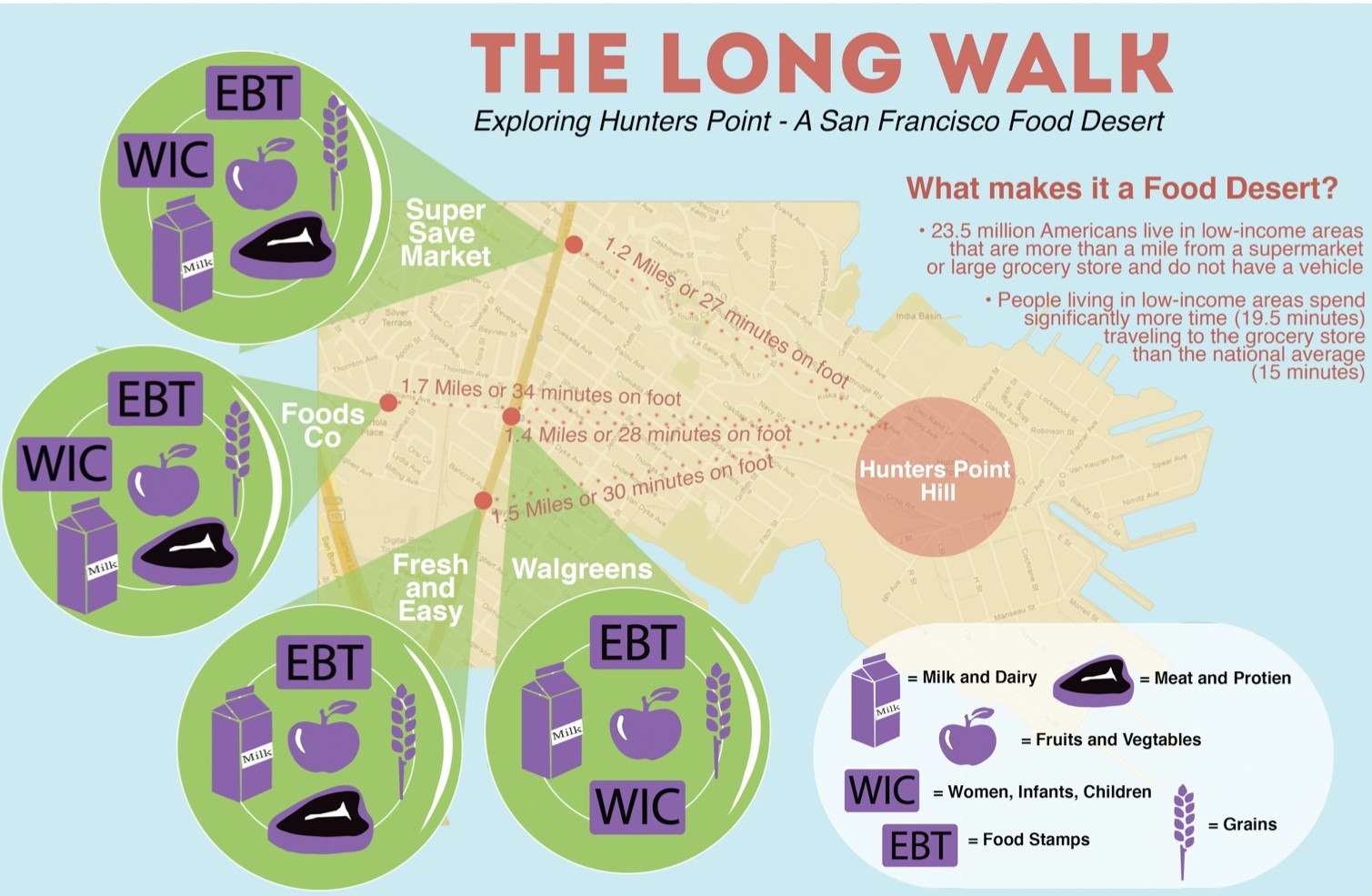
Hunter's Point is listed on the USDA Food Desert Locator and was named one of the "Top 9 Worst US Urban Food Deserts." What I did to examine this issue, is create a visual map and an interactive Google Map that focuses on the Food Desert we have within our city boarders, in Hunter's Point.  The Map I created lists the closest shopping options for the residents of Hunters point, including a key that details the types of food sold and weather or not they support Food Stamps (EBT) and Women Infants and Children (WIC ) coupons for low income mothers. The map also tracks the distance amount of time it takes on foot to travel one-way to the store from the center of Hunter's Point Hill.  Check out the visual map below and the interactive map here.
Source: http://nikiselken.com/wp-content/uploads/2...
Tags design, food desert, hunters point, info graphics
1 Comment

Subscribe

Thank you!

AI Design

Virtual  Reality

Game Design

Emoji Art and Design

Museum Interaction Design

Thesis

What I'm Thinking About

Parsons MFAD+T Projects

No results found

Fresh Posts

A lot of the AI conversation right now is about what machines can create.

This story is about what they might help us recover.

Researchers at Santa Clara University have developed an AI Provenance Assistant to help researchers trace artworks stolen
A lot of the AI conversation right now is about what machines can create. This story is about what they might help us recover. Researchers at Santa Clara University have developed an AI Provenance Assistant to help researchers trace artworks stolen during the Nazi era—searching across fragmented historical records and surfacing connections that might otherwise take enormous amounts of time to find. The AI doesn’t decide who owns a work. Humans still have to verify the evidence. But it can help researchers find the evidence. To me, this is a much more interesting vision of AI: not replacing human expertise, but giving people new ways to navigate enormous amounts of human knowledge. And sometimes, helping recover a history someone tried to erase. Read the full NPR story at the 🔗 link in my bio. #ArtificialIntelligence #AI #ArtHistory #DigitalHumanities #CulturalHeritage
Today is the date Ray Bradbury imagined. August 5, 2026. In There Will Come Soft Rains, an automated house wakes, cooks breakfast, cleans, and reads poetry—long after the people it was built to serve are gone. On August 5th I awoke to a calendar reminder with a link to the story. I don’t remember making the event, but my past self was telling my future self something. So I think it’s worth taking a few minutes to read or listen to this short story. Written in 1950, the story feels eerily close today, as we live alongside AI assistants, smart homes, and increasingly autonomous systems. The machines work perfectly. The humans are gone. For perhaps the most fitting voice to guide us through Bradbury’s future, Leonard Nimoy reads the story in this haunting 1975 recording. 🎧 Listen to the complete recording through the link in my bio. Now that we’ve reached Bradbury’s imagined date, what part of his vision feels most relevant today? Audio: Leonard Nimoy reads Ray Bradbury’s There Will Come Soft Rains, originally released by Caedmon Records in 1975. #RayBradbury #LeonardNimoy #ThereWillComeSoftRains #August52026 #AI SpeculativeFiction ArtificialIntelligence SmartHomes FutureOfTechnology Bookstagram ClassicLiterature DystopianFiction

What I'm Thinking About

  • AI Design (1)
  • Arts for Survival (1)
  • DJing (1)
  • Ko Labs Theater Collective (1)
  • Music Blog (1)
  • Teaching (1)
  • VR (1)
  • Game Design (2)
  • MUSIC (2)
  • Museum Interaction Design (2)
  • Wearables (3)
  • PERFORMANCE (4)
  • Web Design and Code (6)
  • Major Studio 2 (10)
  • Design (16)
  • Parsons MFADT (16)